

South Korea Investment Migration Draws Attention as European Golden Visas Tighten

South Korea’s advanced urban infrastructure and rising prominence as a Northeast Asian hub.
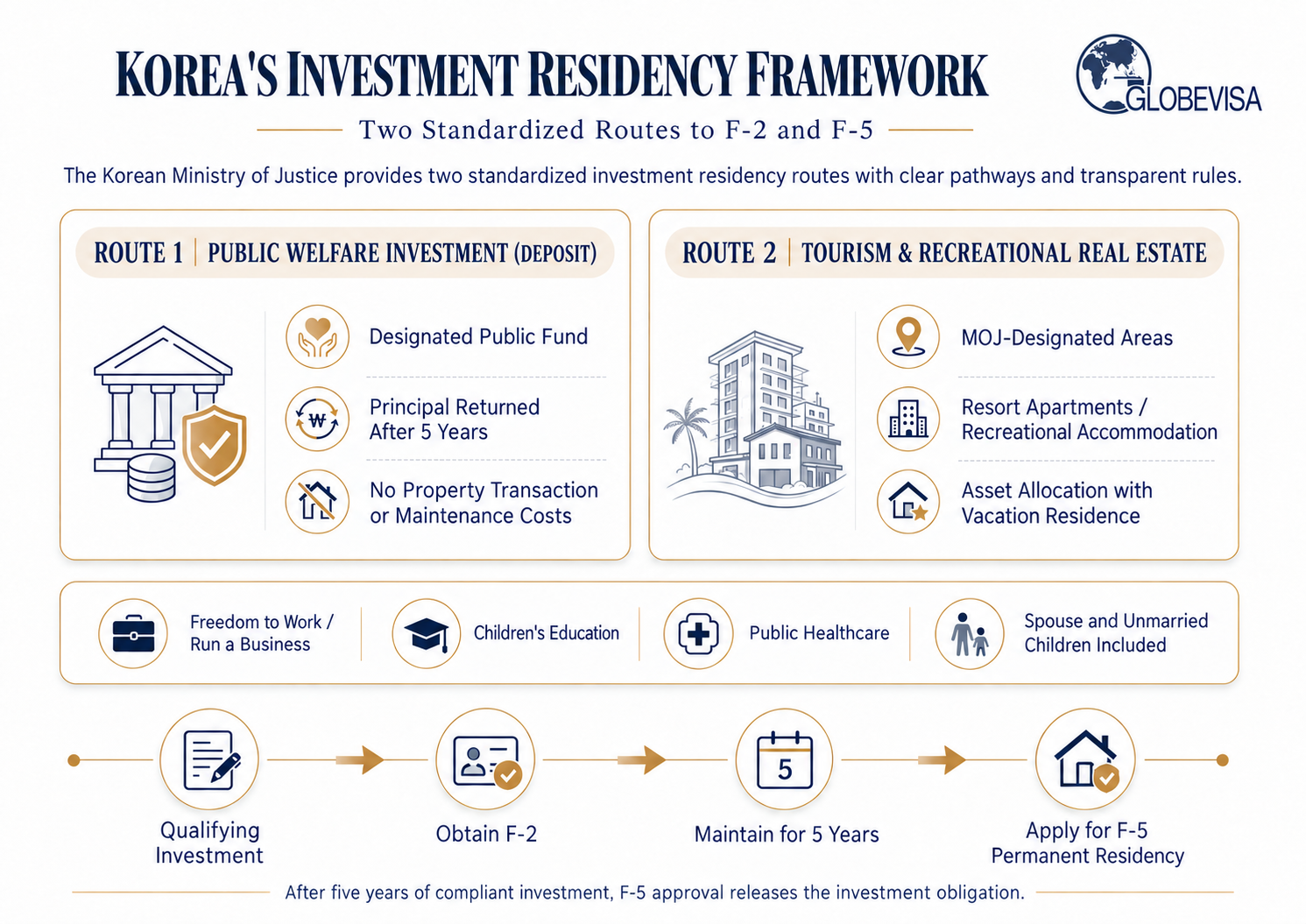
An overview of South Korea’s standardized investment residency framework, illustrating the two official pathways from F-2 long-term residency to F-5 permanent status.
As European golden visas tighten in 2026, global investors evaluate South Korea's fast-track investment residency as a strategic Asian alternative.
SG, SINGAPORE, September 7, 2026 /EINPresswire.com/ -- As of 2026, strategies for acquiring overseas residency among global high-net-worth individuals continue to evolve. According to observations from Globevisa Group, an international residency planning and asset allocation advisory firm, demand across its global consulting network reflects ongoing policy tightening in Europe alongside rising interest in Asian investment residency frameworks. For investors with primary business operations and family ties in Asia, South Korea’s investment residency program has emerged as a key point of comparison.
Shifts in European Golden Visa Policies
Entering 2026, the closure and restructuring of investment residency programs across multiple European countries continue to take effect:
●Closure of Mainstream Programs: Several major European options have ceased accepting new applications. The UK Tier 1 Investor visa ended initial applications in February 2022, Ireland closed its Immigrant Investor Programme (IIP) in 2023, the Netherlands terminated its foreign investor scheme in April 2024, and Spain discontinued new investor visa applications in April 2025.
●Adjustment of Investment Requirements: Among active programs, Portugal eliminated real estate options, pivoting toward employment, research, culture, and non-real-estate fund structures. Greece raised its minimum real estate investment threshold to €800,000 in high-demand regions while introducing stricter restrictions on property usage and leasing.
●Enhanced Source of Funds Scrutiny: Under heightened European anti-money laundering regulations, applicants must provide extensive documentation tracing corporate operations, tax records, and asset accumulation. Due to varying scope across jurisdictions, processing timelines depend on case complexity, document completeness, and immigration authority workloads.
These shifts require investors to evaluate residency programs based on investment structures, capital liquidity, processing efficiency, and physical presence rules, rather than focusing solely on destination preference.
Key Differences Between South Korea and European Programs
When selecting a residency program, investors weigh processing times, capital commitments, maintenance costs, residency requirements, and geographical convenience. Distinct differences exist between South Korea’s framework and European programs:
●Processing Efficiency and Timelines: European program timelines often extend due to backlogs, background checks, and compliance reviews. In contrast, South Korea’s application process generally takes one to two months from preparation to approval. The review focuses primarily on fulfilling statutory investment criteria and standard document verification, subject to application category and immigration processing speeds.
●Source of Funds Verification: Many European programs require exhaustive historical proof of wealth accumulation and corporate tax history. South Korea’s investment residency focuses on verifying that the required capital has been lawfully remitted and fully invested, generally eliminating the need for complex source-of-funds documentation.
●Holding Thresholds and Ongoing Costs: European property-based visas entail ongoing property taxes, maintenance fees, and transaction costs. While real estate options in South Korea carry similar holding costs, its Public Welfare Investment Scheme operates as a principal-guaranteed, non-interest deposit managed by the state-run Korea Development Bank (KDB). This model incurs no operational costs and returns the principal after securing F-5 permanent residency, providing clear capital visibility.
●Residency and Maintenance Requirements: Certain European visas enforce annual physical presence minimums or language proficiency tests. South Korea’s program imposes no language requirements. F-2 visa holders must enter South Korea at least once per year, while F-5 permanent residents must enter once every two years. The F-2 residence card is initially valid for three years, renewable, and eligible for F-5 permanent residency conversion after five years, provided the investment is maintained and compliance conditions are met.
●Geographical Proximity and Mobility: While European golden visas offer Schengen Area mobility, South Korea serves as a major Northeast Asian hub. For investors with primary commercial and family commitments in Asia, its proximity to China, Japan, and major regional markets offers practical travel and operational advantages.
Investment Options and Framework of South Korea’s Program
South Korea’s Ministry of Justice governs investment residency regulations through established legal frameworks. Under the Public Welfare Investment Scheme, qualified foreign investors receive F-2 long-term residence status. After maintaining the investment for five years and meeting statutory conditions, holders may apply to convert to F-5 permanent residency. Spouses and unmarried children are eligible to acquire derivative residence status.
The current framework provides two primary investment pathways:
1.Public Welfare Investment Scheme (Deposit-Based): Applicants deposit the statutory investment amount into a public fund managed by the Korea Development Bank under the mandate of the Ministry of Justice. The principal is returned upon completion of the required holding period, without incurring real estate acquisition taxes or holding fees.
2.Recreation Facility Real Estate Investment Scheme (Property-Based): Established for designated tourism and resort developments, this pathway grants F-2 status for investments meeting government-specified location, asset type, and valuation criteria.
Under F-2 status, investors and their families may legally reside, work, and conduct economic activities in South Korea during the five-year holding period.
Cross-Border Compliance and Application Review
Investment residency applications involve cross-border capital transfers, background verification, and multi-jurisdictional legal documentation. Smooth execution depends on document accuracy, compliant banking channels, and adherence to statutory guidelines.
●Pre-Assessment Protocols: For complex application profiles—such as multi-nationality holders, intricate family structures, or adult unmarried dependents—professional advisory firms conduct pre-submission eligibility reviews. Globevisa indicates that its internal team of immigration lawyers and specialists performs rigorous pre-assessments of applicant qualifications and funding structures to mitigate request-for-evidence (RFE) risks.
●Cross-Border Banking Coordination: Under strict international capital transfer regulations, large-scale investments must be remitted in compliance with South Korean banking and immigration laws. Depending on case requirements, applicants coordinate accounts, remittances, and investment verification certificates with relevant Korean banking institutions. Globevisa leverages its international network across more than 50 countries and regions to coordinate account setup, remittance tracking, and fund confirmation.
●Case Experience and Documentation: Established in 2002, Globevisa Group reports serving over 120,000 families globally. Since the launch of South Korea’s investment residency program, the firm has assisted over 1,300 families in obtaining F-2 residence status and nearly 100 families in completing conversion to F-5 permanent residency. This track record enables advisory teams to streamline document preparation across identity, family relationship, and investment verification requirements.
Investor Evaluation and Long-Term Planning
South Korea’s investment residency program represents a regional alternative designed for individuals managing family, business, and asset allocations within Asia, rather than a direct replacement for European golden visas. Investors evaluating this pathway should balance capital locking periods, statutory criteria, family structure, and actual physical presence needs.
Globevisa Group advises prospective applicants to review current requirements published by South Korean authorities and assess personal funding structures, family circumstances, and long-term residency objectives accordingly. Complex applications involving multi-jurisdictional capital or non-standard family structures require tailored documentation and ongoing monitoring of regulatory updates.
About Globevisa Group
Headquartered in Singapore since 2002, Globevisa Group is a global HNWI wealth management and cross-border identity advisory firm. Backed by institutional-grade risk control, the firm operates 50+ direct branches globally with over 800 in-house professionals. Having processed 120,000+ cases for clients across 120+ countries, Globevisa specializes in citizenship planning, wealth management, and family relocation, empowering international families to achieve barrier-free global settlement.
Globevisa Group Team
Globevisa Group
email us here
Visit us on social media:
LinkedIn
Instagram
Facebook
YouTube
TikTok
X
Legal Disclaimer:
EIN Presswire provides this news content "as is" without warranty of any kind. We do not accept any responsibility or liability for the accuracy, content, images, videos, licenses, completeness, legality, or reliability of the information contained in this article. If you have any complaints or copyright issues related to this article, kindly contact the author above.
